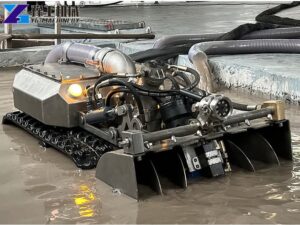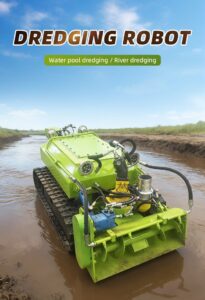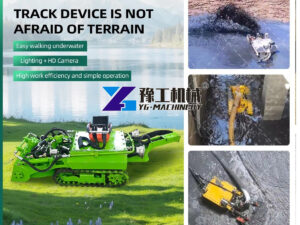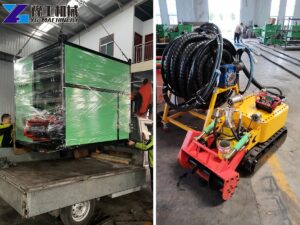

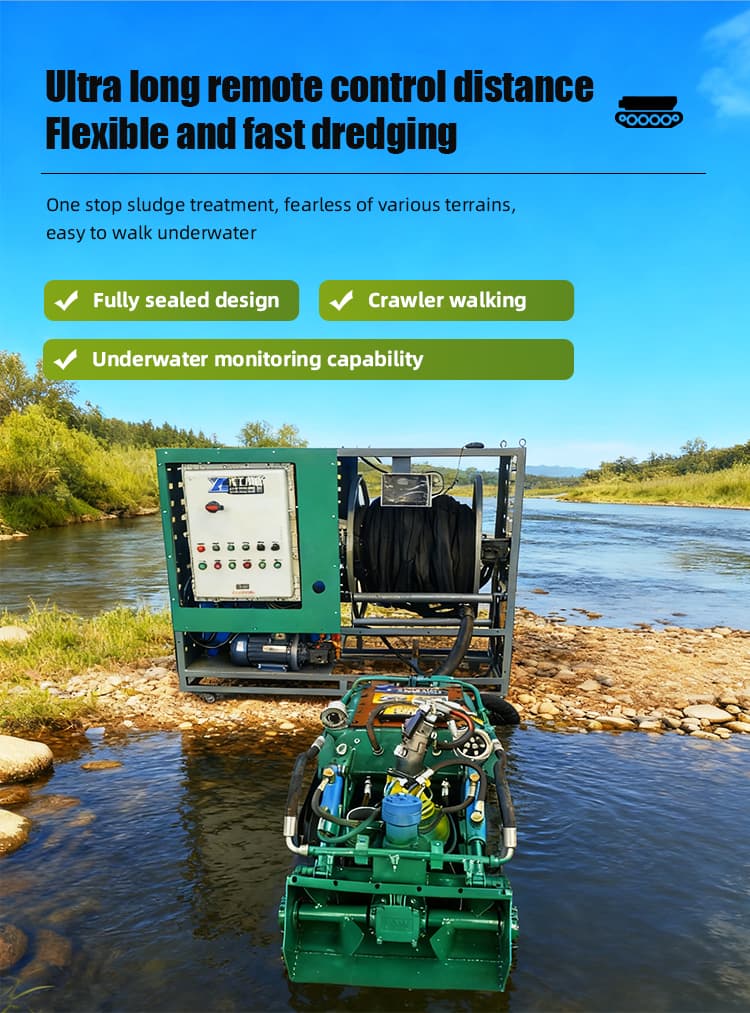
Sludge on a tank floor steals volume and blocks outlets. Hand tools on the bank rarely reach the full layer. Draining the tank stops the line and still leaves thick solids. A dredging robot stays on that floor and pumps the layer to shore. The operator works outside with a wireless remote and two underwater LED lights. You can clean while water stays in the tank. The hydraulic station stays on the bank, so the main motor stays dry and easy to service.
YG Machinery is the manufacturer of this tracked series, from YG-500 to YG-1200. Factory supply means clear specs, stable quality, and a direct price without extra layers. Dredging width runs from 500 mm to 1200 mm. Rated pump flow is 100 or 200 cubic meters per hour. Main motor power is 22 kW, 30 kW, or 45 kW. The pump can pass 15 mm, 38 mm, or 60 mm solids. Standard hydraulic hoses are 50 meters long. Width, hose length, and pump size can be customized. Match the model to your hatch, sludge, and particle size first. Then send your tank data to YG Machinery for a free factory quote.
Factory Parameter Sheet for the Dredging Robot Series
| Parameter | YG-500 | YG-600 | YG-700 | YG-800 | YG-900 | YG-1200 |
|---|---|---|---|---|---|---|
| Robot dimensions | 1500×500×650 mm | 1500×600×650 mm | 1600×700×650 mm | 1600×850×700 mm | 1650×960×750 mm | 1900×1200×750 mm |
| Dredging width | 500 mm | 600 mm | 700 mm | 800 mm | 900 mm | 1200 mm |
| Track travel speed | 3–15 m/s | 3–15 m/s | 3–15 m/s | 3–15 m/s | 3–15 m/s | 3–15 m/s |
| Robot weight | 320 kg | 350 kg | 380 kg | 400 kg | 420 kg | 500 kg |
| Pump output diameter | 3 inch | 3 inch | 4 inch | 4 inch | 4 inch | 4 inch |
| Pump flow rate | 100 m³/h | 100 m³/h | 200 m³/h | 200 m³/h | 200 m³/h | 200 m³/h |
| Hydraulic station dimensions | 2200×1200×1700 mm | 2200×1200×1700 mm | 2200×1200×1700 mm | 2200×1200×1700 mm | 2200×1200×1700 mm | 2120×1240×1200 mm |
| Main motor power | 22 kW | 22 kW | 30 kW | 30 kW | 30 kW | 45 kW |
| Hydraulic system pressure | 0–16 MPa | 0–16 MPa | 0–16 MPa | 0–16 MPa | 0–16 MPa | 0–16 MPa |
| Particle size | 15 mm | 15 mm | 38 mm | 38 mm | 38 mm | 60 mm |
| Reeling system speed | 0–10 r/min | 0–10 r/min | 0–10 r/min | 0–10 r/min | 0–10 r/min | 0–10 r/min |
| Hydraulic hoses | 50 m standard | 50 m standard | 50 m standard | 50 m standard | 50 m standard | 50 m standard |
| Control system | Wireless remote control | Wireless remote control | Wireless remote control | Wireless remote control | Wireless remote control | Wireless remote control |
| Lighting system | Underwater LED lights ×2 | Underwater LED lights ×2 | Underwater LED lights ×2 | Underwater LED lights ×2 | Underwater LED lights ×2 | Underwater LED lights ×2 |
Get Factory Quote | WhatsApp/Tel: +86 183 3715 2861
How Does a Dredging Robot Move Sludge to Shore?
How does the machine move sludge without a person in the water? The system splits wet work and dry power. The crawler and pump run underwater. The hydraulic station stays on the bank.
Working sequence
- Place the hydraulic power pack on firm ground near the tank.
- Connect the 50 m hose bundle from the station to the crawler.
- Lower the robot through the access opening with a hoist.
- Drive the tracks across the tank floor with the wireless remote.
- Start the slurry pump and draw water mixed with settled solids.
- Send the mixture through the discharge hose to a pit or dewatering point.
- Match the discharge hose to the 3-inch or 4-inch pump outlet.
- Use the reeling system at 0–10 r/min to pay hose in or out.
- Adjust hydraulic pressure within 0–16 MPa to match sludge load.
- Lift the crawler for rinse and wear-part checks after the job.
Hydraulic pressure at the top of the range is 160 bar, or about 2,320 psi. This layout is a remote-controlled dredging robot with the power unit kept dry. Some buyers call this crawler a Submersible Dredging Robot. You can service the motor, oil, and filters on shore. Wear parts on the crawler still need a planned lift-out. OSHA treats many tanks, vessels, and pits as confined spaces under 29 CFR 1910.146. Limited entry and a possible bad atmosphere are the usual reasons. Keeping the crew on the bank avoids the entry task. It does not cancel site rules for energy isolation, hose zones, or lifting. Plan those steps before the first shift.

Which Dredging Robot Width and Power Fit Your Tank?
Width is the first selection step. Particle size is the second. Rated flow is the pump capacity of the mixture, not dry mud volume.
Model groups by duty
- YG-500 / YG-600: 500–600 mm path, 320–350 kg, 3-inch outlet, 100 m³/h, 22 kW, 15 mm solids. Best for narrow sumps, channels, and fine silt.
- YG-700 / YG-800 / YG-900: 700–900 mm path, 380–420 kg, 4-inch outlet, 200 m³/h, 30 kW, 38 mm solids. Best for wider tanks with moderate solids.
- YG-1200: 1200 mm path, 500 kg, 4-inch outlet, 200 m³/h, 45 kW, 60 mm solids. Best for large floors when the hatch allows entry.
Selection checks that matter more than model name
- Largest expected stone versus the particle limit on the sheet
- Hatch length, width, and height versus robot body size
- Floor grip: tracks need a bottom they can hold
- Discharge distance and lift versus hose plan and motor power
- Site voltage and frequency for a 22 kW, 30 kW, or 45 kW motor
Do not read 200 m³/h as 200 cubic meters of dry cake. A thin slurry moves more water than solids. A thick layer needs a slower pass and a clear discharge line. Ask us to estimate solids from your sludge sample and hose length. Soft, deep mud may need a site check before shipment.
Where Does a Water Tank Cleaning Robot Fit?
Can one crawler cover a fire water tank and a plant clarifier? Often yes, if the floor, hatch, and solids match the sheet. A water tank cleaning robot fits when silt or sand sits on a firm bottom. Light sludge is also within this duty if the particle cap is respected. The tank can stay partly full, so you avoid a full drain-down.
Common applications
- Fire water tanks and industrial recycle tanks
- Cooling-tower basins
- Primary clarifiers and sedimentation tanks between larger shutdowns
- Mine sumps and plant basins with a firm floor
- Culverts and narrow channels (YG-500 or YG-600)
- Wide lagoons when the hatch allows YG-900 or YG-1200
Clear limits
- Not a cutter-suction dredger for rock or long river bars
- Not a process guarantee for effluent quality
- Solids above 60 mm need a larger passage or a screen
- Open ponds still need a bank strong enough for the hydraulic station
- Discharge must fit within the hose plan
For a sedimentation tank cleaning robot, send water depth, sludge thickness, and the longest discharge run. Those three numbers decide hose length and motor size more than the model name does.


Crawler Dredging Robot for Sale: What Should You Check?
A crawler dredging robot for sale should be judged on limits, not on a single flow number. Start with the mixture, not a peak brochure line. Rated flow is the volume of water plus solids.
Flow example (not a promise)
- If solids are about one-tenth of the volume, use the 200 m³/h rating as the base.
- That implies about 20 cubic meters of solids each hour, before losses.
- Real sludge is not that even.
- Hose friction further cuts the rate.
- Standard hydraulic hose is 50 m; longer runs need a pressure check.
Site data checklist before you buy
- Hatch size versus robot length, width, and height
- Floor condition, slope, and obstacles such as pipes or baffles
- Water depth and the longest path from the bank to the far wall
- Spudge thickness, density if known, and the largest particle
- Discharge distance, lift, and where the slurry will go
- Electric supply for a 22 kW, 30 kW, or 45 kW motor
- Space for a station about 2.2 m long and up to 1.7 m high
- Lifting gear for a robot of 320 kg to 500 kg
- Hose route, walkways, and a safe stand for the operator
Track speed is adjustable, so the operator can slow down in thick sludge. Use a quicker pass only when the floor is firm, and the layer is thin.
YG Machinery Support, Parts, and How to Request a Quote
YG Machinery supplies these tracked units to plant owners and contractors. We handle the steps around the machine, not only the shipment.
What we need from you
- Sketch or photos of the tank
- Water depth and sludge thickness
- Largest stone or particle you can see
- Hatch size and site power
- Preferred discharge point
What you receive
- One matched model and hose plan
- Written quote before the crate leaves
- Custom width and extra hose length if needed
- Install guidance by video or phone
- Remote technical support after startup
- Wear parts: pump wet-end parts, seals, track shoes, hoses, LED lamps
Simple maintenance rhythm
- Check hydraulic oil, hose skins, and the pump inlet after each job
- Rinse the crawler before the silt dries
- Store the remote and lamps in a dry box
- Set a monthly inspection if the robot works daily
- Join the check with our technician by video when needed
Send the tank size, the sludge type, and the discharge point. Request a free quote and a custom layout today. We answer with a model number, the matching sheet row, and a clear offer.
Request Solution for My Business


Frequently Asked Questions about the Submersible Dredging Robot
A1: YG-500 and YG-600 are rated at 100 m³/h. YG-700 through YG-1200 are rated at 200 m³/h. These figures are the pump capacity of the mixture, not the dry solids volume.
A2: YG-500 and YG-600 pass up to 15 mm. YG-700, YG-800, and YG-900 pass up to 38 mm. YG-1200 passes up to 60 mm. Larger stones can block the pump.
A3: Yes, in many cases. The crawler runs on the floor while water remains. Confirm hatch size, floor strength, and discharge path first.
A4: Standard length is 50 m. Longer runs add pressure loss. Ask for a custom hose check before you order.
A5: One operator uses a wireless remote control from the bank. Two underwater LED lights aid visibility. The hydraulic station stays on shore.